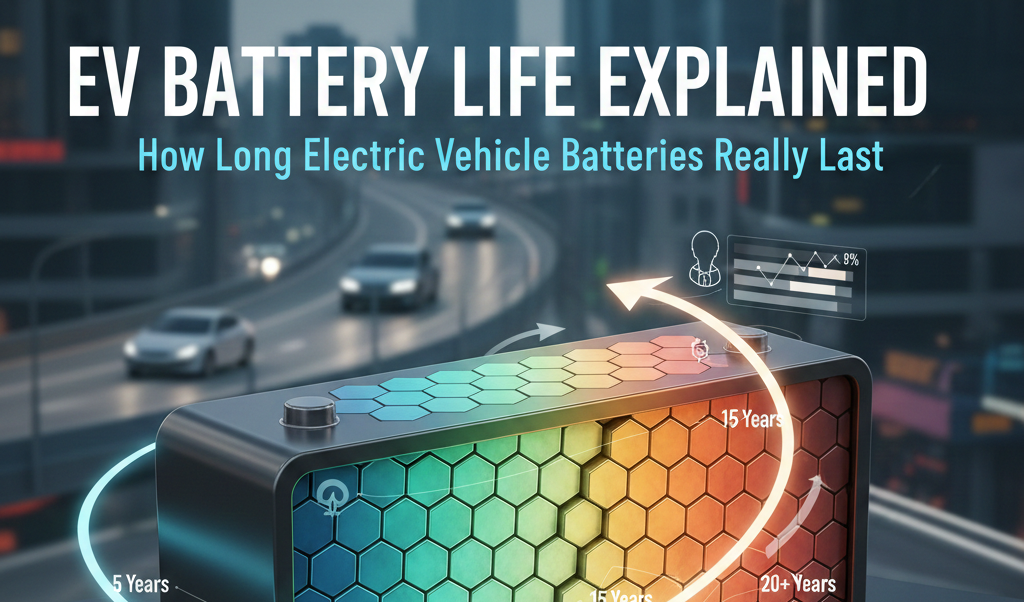
Electric Vehicles (EVs) are no longer a future concept—they are becoming a normal part of daily life in India and around the world. With rising fuel prices, environmental concerns, and government support, more people are seriously considering switching to electric cars and scooters. However, one question still worries most buyers: How long does an EV battery last?
EV battery life is often misunderstood. Many people assume that an electric vehicle battery will fail quickly or cost a fortune to replace. In reality, modern EV batteries are designed to last much longer than most people expect. This article explains EV battery life in simple terms, covering lifespan, degradation, charging habits, climate impact, and tips to extend battery health.
Understanding EV batteries and how they work?
An EV battery is the heart of an electric vehicle. Unlike petrol or diesel vehicles that rely on engines, EVs store electrical energy in large battery packs and use it to power electric motors.
Most modern electric vehicles use lithium-ion batteries, similar to those found in smartphones but far more advanced and durable. These batteries are designed to handle thousands of charging cycles while delivering consistent performance.
Instead of wearing out suddenly, EV batteries slowly lose capacity over time—a process known as battery degradation.
What Does EV Battery Life Actually Mean?
EV battery life does not mean the battery suddenly stops working after a certain number of years. Instead, it refers to how much of its original capacity the battery can retain over time.
- A new EV battery may offer 100% range
- After several years, it may retain 80–90% capacity
- The vehicle still works perfectly, but range reduces slightly
Most manufacturers consider an EV battery to be usable as long as it retains around 70% capacity.
Average Lifespan of an EV Battery
Most modern EV batteries are developed to provide long-lasting performance:
- 8 to 15 years, depending on usage
- 1.5 to 3 lakh kilometers or more
This means for most private vehicle owners, the battery often lasts as long as or longer than the vehicle itself.
Many EV manufacturers also provide long battery warranties, which shows confidence in battery durability.
EV Battery Warranty Explained
Battery warranty is one of the strongest indicators of expected battery life.
Most EV manufacturers offer:
- 8 years or 1,60,000 km warranty (whichever comes first)
- Guaranteed minimum capacity retention (usually 70%)
If the battery degrades beyond the promised level during the warranty period, the manufacturer repairs or replaces it.
This significantly reduces the financial risk for EV buyers.
Factors That Affect EV Battery Life
EV battery life depends on several real-world factors. Understanding them helps owners take better care of their vehicles.
Charging Habits
Frequent fast charging generates more heat, which can accelerate battery degradation over time. While fast chargers are convenient, regular slow charging is healthier for the battery.
Charging to 100% daily or letting the battery drop to 0% frequently can also impact long-term health.
Driving Style
Aggressive acceleration and high-speed driving put more load on the battery. Smooth driving helps maintain battery efficiency and longevity.
Climate and Temperature
Extreme heat is one of the biggest enemies of lithium-ion batteries. EVs operating in very hot climates may experience slightly faster degradation if not properly managed.
Modern EVs use battery management systems to control temperature, which significantly reduces this impact.
Battery Management System (BMS)
The BMS is the brain of the battery. It regulates charging, discharging, temperature, and safety. A good BMS can greatly extend battery life by preventing harmful conditions.
EV Battery Degradation: What to Expect Over Time
Battery degradation is gradual and predictable.
Typical degradation pattern:
- First year: Minor capacity drop (2–3%)
- Next few years: Slow and stable decline
- After 8–10 years: Battery may retain 70–80% capacity
This means an EV that initially offered 300 km range may still offer 220–240 km even after many years, which is still sufficient for daily use.
Can EV Batteries Be Repaired or Replaced?
EV batteries are modular, meaning they consist of multiple cells or modules.
In many cases:
- Individual battery modules can be repaired or replaced
- Full battery replacement is not always required
As EV adoption increases, battery repair ecosystems are improving, and costs are expected to reduce further in the future.
Cost of EV Battery Replacement
Battery replacement costs depend on:
- Battery size
- Vehicle type
- Technology used
Currently, battery replacement can be expensive, but prices are falling rapidly due to better manufacturing, recycling, and improved energy density.
For most owners, battery replacement is unlikely during the normal ownership period, especially with warranty coverage.
How to Increase EV Battery Life
Simple habits can significantly improve battery longevity:
- Avoid charging to 100% every day unless needed
- Do not regularly drain the battery to 0%
- Prefer slow or moderate charging
- Park in shaded or covered areas
- Avoid unnecessary fast charging
- Keep software updates up to date
EV Battery Life vs Petrol Engine Life
Compared to petrol engines, EV batteries have fewer moving parts and experience less mechanical wear.
Petrol engines:
- Require oil changes
- Have complex mechanical components
- Suffer from wear and tear
EV batteries:
- No moving parts
- Minimal routine maintenance
- Predictable degradation
In many cases, EV powertrains outlast traditional engines.
Second Life of EV Batteries
Even after EV batteries are no longer ideal for vehicles, they are far from useless.
Used EV batteries can be repurposed for:
- Home energy storage
- Solar power storage
- Backup power systems
This “second life” further increases the overall value and sustainability of EV batteries.
Are EV Battery Myths True?
Some common myths include:
- EV batteries die quickly
- Batteries fail suddenly
- Replacement is always required after warranty
In reality, real-world data shows that modern EV batteries are durable, reliable, and long-lasting when used correctly.
Why EV Battery Life Is Improving Every Year
Battery technology is evolving rapidly. Improvements in chemistry, thermal management, and software have dramatically increased battery durability over the last decade.
Future EV batteries are expected to:
- Last longer
- Charge faster with less degradation
- Be cheaper to replace
- Offer higher energy density
Final Thoughts
EV battery life is no longer a major concern it once was. Modern electric vehicle batteries are built to last for many years, often matching or exceeding the lifespan of conventional vehicles.
With proper charging habits, sensible driving, and manufacturer support, EV batteries can deliver reliable performance throughout the ownership period. Instead of worrying about battery life, buyers should focus on choosing the right EV for their needs.
In simple terms, an EV battery is not a weakness—it is one of the strongest parts of an electric vehicle.