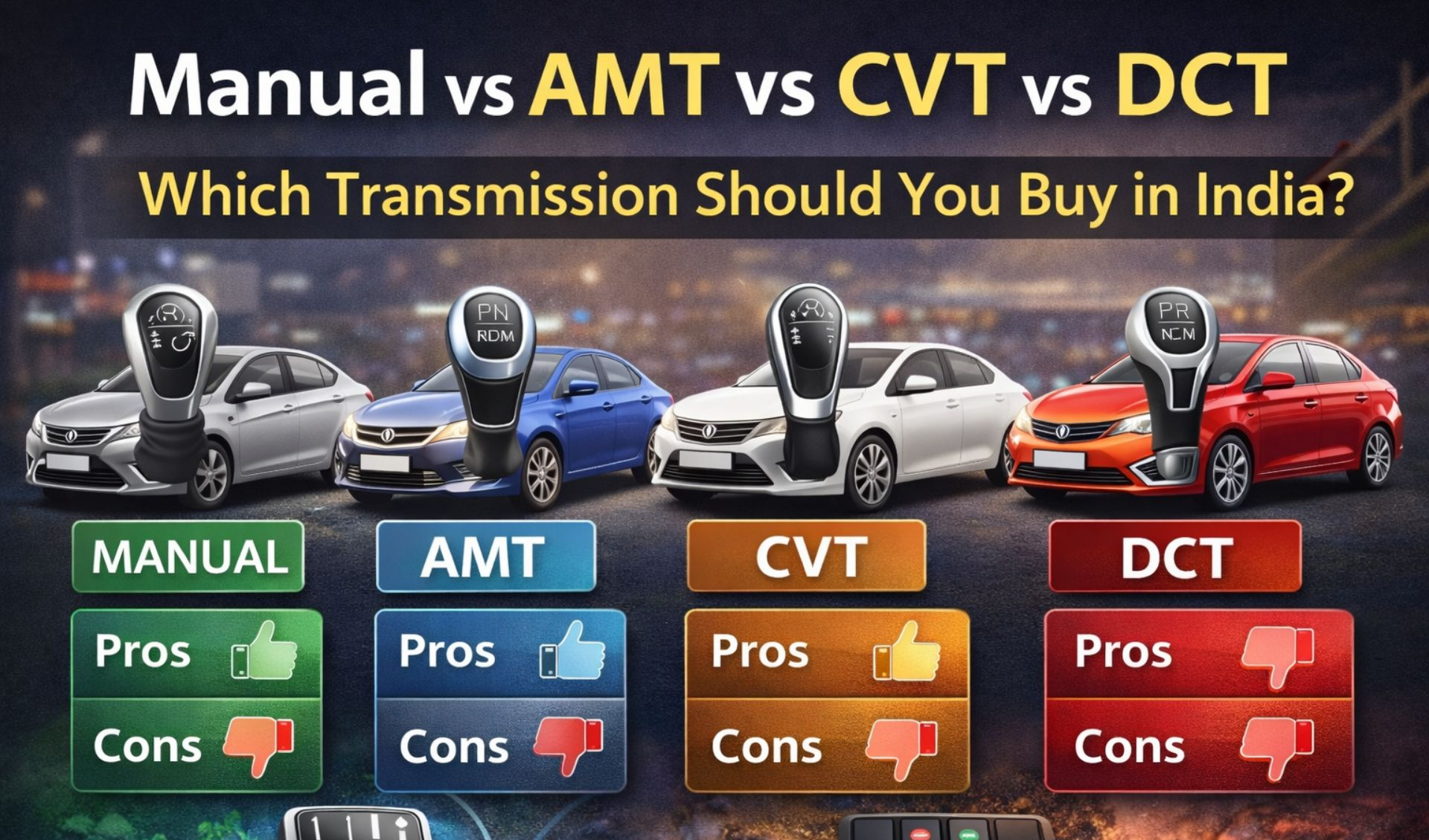
Choosing the right car transmission has become one of the biggest dilemmas for Indian car buyers today. With rising traffic congestion, longer daily commutes, and increasing availability of automatic cars, many buyers are confused about whether to buy a manual car or an automatic one. And if automatic, which option is better — AMT, CVT, or DCT?
Each transmission type has its own advantages, limitations, and ideal usage scenarios. This detailed buyer guide will help you understand the real-world differences between Manual, AMT, CVT, and DCT, so you can choose the best transmission based on your budget, driving habits, and long-term ownership plans.
1. Manual Transmission: Traditional, Reliable, and Budget-Friendly
What Is a Manual Transmission?
A manual transmission involves the driver controlling the clutch pedal and changing gears by hand with a gear lever. It remains the most conventional and commonly used transmission in India, particularly in budget and mid-range vehicles.
Advantages of Manual Transmission
- Lower purchase cost compared to automatics
- Better control over gear selection
- High reliability and mechanical simplicity
- Lower maintenance and repair costs
- Good fuel efficiency when driven properly
Disadvantages of Manual Transmission
- Can be tiring in heavy city traffic
- Not beginner-friendly for new drivers
- Frequent clutch usage increases fatigue
Who Should Buy a Manual Car?
- Budget-conscious buyers
- Highway-focused drivers
- Driving enthusiasts who enjoy control
- Buyers planning long-term ownership
2. AMT (Automated Manual Transmission): Affordable Automatic Option
What Is AMT?
AMT, or Automated Manual Transmission, is essentially a manual gearbox where the clutch and gear shifting are automated using electronic actuators.
Advantages of AMT
- Cheapest automatic transmission option
- Better fuel efficiency compared to other automatics
- Low maintenance cost
- Convenient for daily city traffic
Disadvantages of AMT
- Noticeable lag during gear shifts
- Jerky driving experience at low speeds
- Not suitable for enthusiastic driving
Who Should Buy an AMT Car?
- First-time automatic car buyers
- Daily city commuters
- Buyers upgrading from a manual car
- Those who want comfort on a budget
3. CVT (Continuously Variable Transmission): Smooth and Comfortable
What Is CVT?
A CVT does not rely on conventional gears. Instead, it works with a belt and pulley mechanism that delivers a continuously variable range of gear ratios, allowing for very smooth acceleration and a seamless driving experience.
Advantages of CVT
- Very smooth and jerk-free driving experience
- Excellent comfort in stop-and-go traffic
- Good fuel efficiency in city conditions
- Ideal for relaxed driving
Disadvantages of CVT
- Rubber-band effect during hard acceleration
- Engine noise can feel disconnected
- Repair costs can be higher than AMT
Who Should Buy a CVT Car?
- City-focused drivers
- Comfort-oriented buyers
- Families looking for smooth rides
- Drivers who prefer relaxed driving
4. DCT (Dual-Clutch Transmission): Performance-Oriented Automatic
What Is DCT?
DCT uses two separate clutches — one for odd gears and one for even gears. This allows extremely fast gear shifts, making it the most performance-focused automatic transmission.
Advantages of DCT
- Lightning-fast gear shifts
- Sporty and engaging driving experience
- Better acceleration compared to other automatics
- Manual-like performance without clutch usage
Disadvantages of DCT
- Most expensive transmission type
- Higher maintenance and repair costs
- Older DCTs may overheat in heavy traffic
Who Should Buy a DCT Car?
- Driving enthusiasts
- Buyers of premium cars
- Highway-focused users
- Performance-oriented drivers
5. Mileage Comparison: Manual vs AMT vs CVT vs DCT
Fuel efficiency depends heavily on driving style, but generally:
- Manual: Highest mileage potential
- AMT: Close to manual efficiency
- CVT: Efficient in city driving
- DCT: Slightly lower due to performance tuning
6. Maintenance & Reliability Comparison
- Manual: Lowest maintenance, highly reliable
- AMT: Slightly higher than manual
- CVT: Moderate maintenance costs
- DCT: Highest maintenance cost
7. City vs Highway Usage
- Best for City: CVT, AMT
- Best for Highway: Manual, DCT
- Mixed Usage: CVT
8. Transmission Comparison Table
| Transmission |
Comfort |
Performance |
Maintenance Cost |
Best For |
| Manual |
Medium |
High |
Low |
Budget & Control |
| AMT |
Medium |
Low |
Low |
City Commuters |
| CVT |
High |
Medium |
Medium |
Comfort Seekers |
| DCT |
High |
Very High |
High |
Enthusiasts |
9. FAQs – Car Transmission Guide
Is automatic transmission better than manual?
Automatic transmissions offer better comfort in traffic, while manuals offer better control and lower costs.
Which automatic transmission is the most reliable?
AMT and CVT are generally more reliable and cost-effective for daily city driving.
Is DCT suitable for Indian traffic?
Modern DCTs are better than older ones, but they are still best suited for highways and open roads.
Real-World Buying Factors Most People Ignore While Choosing a Transmission
While brochures and spec sheets explain how Manual, AMT, CVT, and DCT work, real ownership experience often depends on factors that buyers usually overlook. Understanding these practical aspects can help you avoid regret after purchase and choose a transmission that truly fits your lifestyle.
Traffic Conditions Matter More Than You Think
Indian driving conditions are unique. Bumper-to-bumper traffic, frequent speed breakers, poor road surfaces, and unpredictable driving behavior make transmission choice critical. If your daily drive involves long traffic jams, constant clutch usage in a manual car can quickly become exhausting. In such cases, AMT or CVT offers significant relief, even if they lack sporty performance.
On the other hand, if you mostly drive on highways or open roads, the advantages of a manual or DCT become more noticeable.
Long-Term Ownership and Repair Costs
Many buyers focus only on the initial price difference between manual and automatic cars. However, long-term maintenance costs play an equally important role. Manual gearboxes are mechanically simple and can last for years with minimal maintenance. AMTs also remain affordable to maintain due to their manual-based construction.
CVT and DCT transmissions, while technologically advanced, are more complex systems. Repairs outside warranty can be expensive, especially for DCT-equipped cars. If you plan to keep your car for more than 7–8 years, this factor becomes extremely important.
Driving Style and Personality
Your driving style should directly influence your transmission choice. If you enjoy controlling engine speed, timing gear shifts, and feeling connected to the car, a manual transmission will feel more satisfying. DCTs also appeal to enthusiasts who want fast gear changes without using a clutch.
If you prefer calm, stress-free driving and prioritize comfort over involvement, CVT transmissions are ideal. They are designed for smooth progress rather than aggressive acceleration. AMTs sit somewhere in between, offering convenience without targeting performance.
Resale Value and Market Preference
Automatic cars are gaining popularity rapidly in India, especially in urban markets. AMT and CVT models generally enjoy better resale value in cities due to rising demand. Manual cars still hold strong resale appeal in smaller towns and rural areas, where buyers prefer simplicity and lower repair costs.
DCT cars, while desirable, have a smaller resale audience because buyers are cautious about long-term reliability and repair expenses.
Future-Proofing Your Purchase
With increasing urban congestion and evolving driving habits, automatic transmissions are becoming the norm. If this is your first car or you expect your driving conditions to worsen over time, choosing an automatic can be a future-ready decision. However, the “best” transmission is not the most advanced one — it is the one that aligns with how and where you drive every day.
Final Verdict: Which Transmission Should You Buy?
Choose Manual if you want low cost and full control.
Choose AMT if you want an affordable automatic for city use.
Choose CVT if comfort and smoothness matter most.
Choose DCT if performance and driving pleasure are your priorities.
There is no single best transmission for everyone. The right choice depends on your budget, driving environment, and long-term usage. Make an informed decision, not a trend-based one.