Search

    Language Settings
    Select Website Language

    GDPR Compliance

    We use cookies to ensure you get the best experience on our website. By continuing to use our site, you accept our use of cookies, Privacy Policy, and Terms of Service.

    Helmet Fine in Different States of India

    21 hours ago

    Two-wheelers are an essential part of everyday life in India. From office commutes and college travel to delivery work and household errands, bikes and scooters dominate Indian roads. However, with convenience comes responsibility, and one of the most important responsibilities for any two-wheeler rider is wearing a helmet.

    Despite clear laws, helmet violations remain common across the country. Many riders either underestimate the risk or are unaware of the helmet fine applicable in different Indian states. While traffic laws are guided by a central framework, enforcement often varies at the state level.


    Why Wearing a Helmet Is Mandatory in India

    A helmet is not just a legal formality; it is a critical safety tool. Head injuries are among the leading causes of death in two-wheeler accidents. Even a low-speed fall can result in serious head trauma if a rider is not wearing proper protection.

    The Indian government has made helmet usage mandatory to reduce road fatalities and serious injuries. The rule applies to both motorcycles and scooters and, in most states, to pillion riders as well.


    Helmet Fine Under the Motor Vehicles Act

    According to the amended Motor Vehicles Act, riding a two-wheeler without a helmet can attract a fine of up to ₹1,000. In some cases, authorities may also impose additional penalties such as temporary suspension of the driving licence.

    However, since traffic law enforcement is handled by state governments, the strictness of implementation can vary across regions.


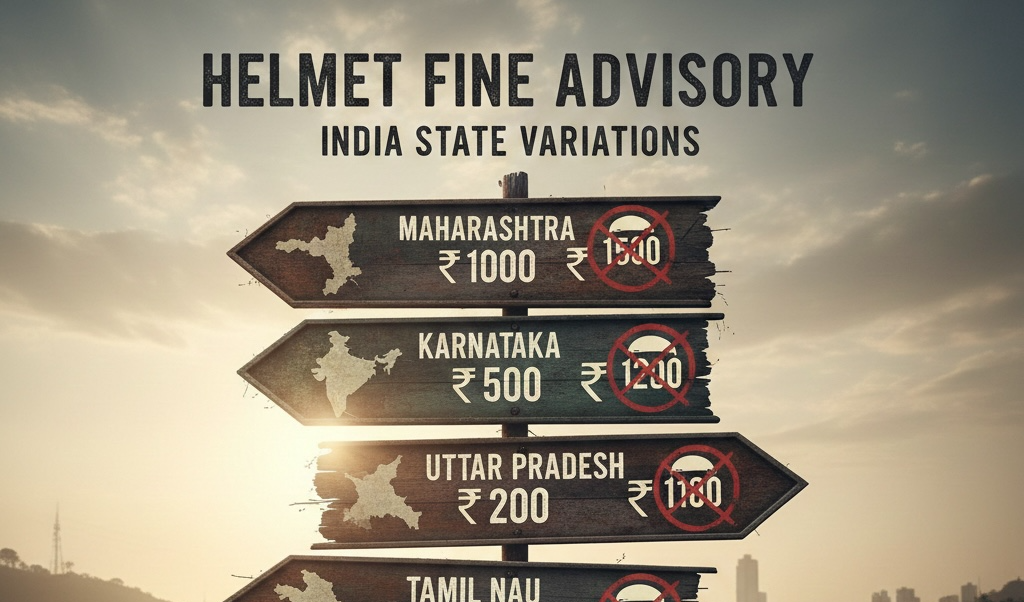
    Helmet Fine in Different States of India

    Below is a general overview of how helmet fines are enforced in major Indian states. The exact amount and strictness may vary depending on local notifications and enforcement drives.

    Helmet Fine in Delhi

    Delhi follows strict helmet enforcement policies. Helmets are mandatory for both riders and pillion riders.

    • Fine amount: Up to ₹1,000
    • Licence suspension possible for repeat offenders
    • High enforcement through traffic cameras and challans

    Helmet Fine in Maharashtra

    Maharashtra enforces helmet rules strongly, especially in cities like Mumbai and Pune.

    • Fine amount: ₹500 to ₹1,000
    • Pillion helmet compulsory
    • Regular traffic police drives

    Helmet Fine in Uttar Pradesh

    Uttar Pradesh enforces helmet rules under central guidelines, with increasing strictness in urban areas.

    • Fine amount: Up to ₹1,000
    • Enforcement stronger in major cities

    Helmet Fine in Karnataka

    Karnataka, especially Bengaluru, is known for strict traffic enforcement.

    • Fine amount: ₹500 to ₹1,000
    • Mandatory for rider and pillion
    • CCTV-based challans common

    Helmet Fine in Tamil Nadu

    Tamil Nadu maintains consistent helmet enforcement across major cities.

    • Fine amount: Around ₹1,000
    • Pillion helmet compulsory
    • High compliance in urban areas

    Helmet Fine in Telangana

    Telangana enforces helmet rules strictly in cities like Hyderabad.

    • Fine amount: ₹1,000
    • Traffic camera monitoring

    Helmet Fine in Rajasthan

    Rajasthan follows central rules, with stricter enforcement in major tourist and urban cities.

    • Fine amount: ₹500 to ₹1,000
    • Enforcement stronger in Jaipur and Udaipur

    Helmet Fine in West Bengal

    West Bengal has improved helmet enforcement in recent years.

    • Fine amount: ₹500 to ₹1,000
    • Mandatory for rider and pillion

    Helmet Fine in Gujarat

    Gujarat enforces helmet rules seriously in urban regions.

    • Fine amount: Up to ₹1,000
    • Regular checking in cities

    Helmet Fine in Kerala

    Kerala has relatively high road safety awareness and strong helmet compliance.

    • Fine amount: ₹500 to ₹1,000
    • Helmet mandatory for rider and pillion

    Pillion Helmet Rule: A Common Misunderstanding

    Many riders believe that pillion riders do not require helmets. In reality, most Indian states now mandate helmets for both riders and pillion riders, regardless of gender. Violations can result in fines for the rider, the pillion, or both.


    Why Helmet Fines Are Becoming Stricter

    Helmet fines are not imposed merely to penalize riders. The main objective is to reduce road accident fatalities. Stricter enforcement has been proven to increase helmet usage and save lives.

    Authorities aim to create a culture where wearing a helmet becomes a habit rather than a compulsion.


    Common Helmet-Related Mistakes Riders Make

    • Using non-ISI certified helmets
    • Wearing half helmets or damaged helmets
    • Not fastening the chin strap
    • Pillion rider not wearing a helmet

    How to Avoid Helmet Fines

    Avoiding helmet fines is simple. Always wear an ISI-certified helmet, ensure proper fit, and carry a helmet for both rider and pillion. More importantly, remember that a helmet is meant to protect your life, not just save you from a challan.


    Final Thoughts

    Helmet fines may vary slightly across Indian states, but the message is uniform nationwide: wearing a helmet is mandatory. The cost of a fine is insignificant compared to the risk of severe injury or loss of life.

    By following helmet rules, riders not only comply with the law but also contribute to safer roads for everyone. A helmet does not just protect your head—it protects your future.

    Click here to Read More
    Previous Article
    Bajaj Chetak C2501 : A Smart, Affordable Electric Scooter for Everyday India
    Next Article
    Vehicle Insurance Claim Process in India: A Complete Guide

    Related EV Bike News Updates:

    Are you sure? You want to delete this comment..! Remove Cancel

    Comments (0)

      Leave a comment