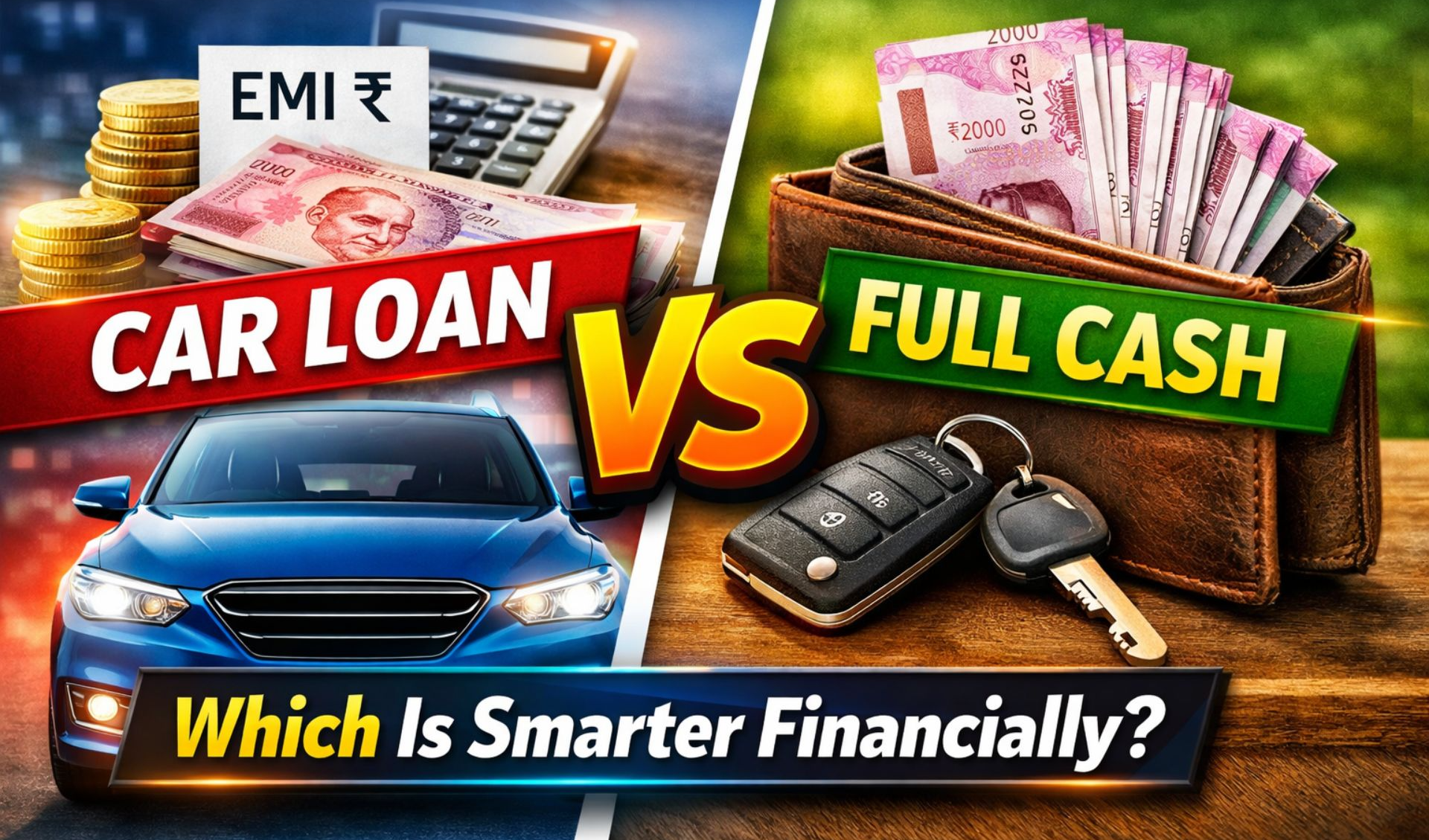
Buying a car is one of the biggest financial decisions for most Indian households. Once you finalize the model and variant, one important question still remains:
Should you buy a car on a loan or pay the full amount in cash?
Some people believe “Cash is king” and loans are bad. Others feel taking a car loan is smarter and keeps money free for investments. In this detailed guide, we’ll break down car loan vs full cash payment from a financial, practical, and long-term perspective, so you can make the smartest decision for your situation.
Understanding the Two Options Clearly
What Does Full Cash Payment Mean?
A full cash payment means you pay the entire on-road price of the car upfront without any loan. No EMIs, no interest, and no long-term commitment.
What Is a Car Loan?
A car loan allows you to buy the car by paying a small down payment, while the remaining amount is paid in monthly EMIs over a fixed tenure (usually 3–7 years), along with interest.
Upfront Cost Comparison
Full Cash Payment
- Requires a large lump-sum amount
- Entire savings get blocked at once
- No monthly financial obligation later
Car Loan
- Lower initial burden
- Typical down payment: 10–20%
- Monthly EMI spreads the cost over time
Verdict:
If liquidity is important to you, a car loan is easier upfront. Cash payment is only comfortable if you have surplus funds.
Interest Cost: The Biggest Difference
Car Loan Interest
Car loans in India usually carry 8%–11% interest, depending on:
- Credit score
- Bank/NBFC
- Loan tenure
Example:
- Car price: ₹10 lakh
- Loan amount: ₹8 lakh
- Tenure: 5 years
- Interest paid: ₹1.5–2 lakh (approx)
Full Cash Payment
- Zero interest
- Car costs exactly what you pay
Verdict:
From a pure cost perspective, cash payment is cheaper.
Opportunity Cost: The Hidden Angle Most Buyers Ignore
If You Pay Full Cash
Your ₹10–15 lakh is locked into a depreciating asset (a car loses value every year).
If You Take a Loan
You can:
- Invest your remaining money in:
- Mutual funds
- Fixed deposits
- Business
- Real estate
- Potentially earn 12–15% returns
If your investment returns are higher than loan interest, the loan actually makes financial sense.
Verdict:
For disciplined investors, car loan + smart investment can be smarter than cash.
Impact on Savings & Emergency Funds
Full Cash Payment
- Emergency fund may get wiped out
- Financial flexibility reduces
- Risky if income is uncertain
Car Loan
- Savings remain intact
- Emergency funds stay safe
- Better for job switches or medical emergencies
Verdict:
A car loan offers better financial safety net.
EMI Pressure & Mental Peace
Car Loan
- Monthly EMI pressure
- Reduces monthly disposable income
- Can feel stressful during income uncertainty
Cash Payment
- No EMI tension
- Complete peace of mind
- Car truly feels “yours”
Verdict:
If mental peace matters more than financial optimization, cash wins.
Tax Benefits: Is There Any?
For individual salaried buyers, there is no direct tax benefit on car loans.
However:
- Business owners can claim:
- Interest as expense
- Depreciation
- Professionals using cars for work get partial benefits
Verdict:
For business owners, loan is usually smarter.
Depreciation vs Loan Balance
Cars depreciate fast:
- 1st year: 15–20%
- 3 years: 40–50%
- 5 years: 60%+
With a loan:
- Sometimes loan balance > car resale value (negative equity)
With cash:
Verdict:
Cash buyers are safer from depreciation-related stress.
Credit Score Impact
Car Loan
- Timely EMIs improve credit score
- Helpful for future home loans
- Missed EMIs can damage score
Cash Payment
- No impact on credit history
Verdict:
If you want to build credit history, a car loan helps.
Flexibility to Upgrade or Sell
Loan Car
- Need loan closure before selling
- Slightly complicated process
Cash Car
- Easy resale anytime
- No bank involvement
Verdict:
Cash buyers enjoy maximum flexibility.
When Is Full Cash Payment Smarter?
- You have surplus money
- Emergency fund is already secured
- You dislike debt
- You plan long-term ownership
- You are close to retirement
- Loan interest feels unnecessary
When Is a Car Loan Smarter?
- You want to preserve savings
- You are a salaried professional
- You can invest surplus money wisely
- You have a stable income
- You want to build credit score
- Inflation makes future money cheaper
Hybrid Approach: The Best of Both Worlds
- Higher down payment (40–60%)
- Short loan tenure (2–3 years)
- Lower interest burden
- Some liquidity remains
This approach balances financial discipline + peace of mind.
Psychological Factor: Emotional vs Logical Decision
Buying a car is emotional:
- “No EMI” feels satisfying
- Loan feels like a burden
But financially:
- Loans can be tools if used wisely
- Cash is safest but not always optimal
Smart buyers combine logic with comfort.
Car Loan vs Full Cash Payment – Quick Comparison
| Factor |
Car Loan |
Full Cash Payment |
| Initial Payment |
Low (10–20% down payment) |
High (100% on-road price) |
| Interest Cost |
Yes (8–11% approx) |
No interest |
| Monthly EMI |
Yes |
No EMI |
| Impact on Savings |
Savings remain available |
Savings get blocked |
| Emergency Fund Safety |
Better protected |
May get affected |
| Investment Opportunity |
Possible (invest surplus money) |
Limited |
| Mental Peace |
EMI pressure exists |
Complete peace of mind |
| Credit Score Impact |
Improves if EMIs are paid on time |
No impact |
| Resale / Upgrade Flexibility |
Loan closure required |
Easy resale anytime |
| Best For |
Salaried & investment-focused buyers |
Debt-free & conservative buyers |
Frequently Asked Questions (FAQs)
Is it better to buy a car on loan or pay cash in India?
Both options are good depending on your financial situation. Cash payment is better if you have surplus funds and want peace of mind. A car loan is smarter if you want to preserve savings and invest your money elsewhere.
Does buying a car on loan increase total cost?
Yes. When you buy a car on loan, you pay interest over the loan tenure, which increases the overall cost compared to full cash payment.
Is it financially smart to take a car loan even if I have cash?
Yes, if you can invest your cash and earn returns higher than the car loan interest rate. In that case, a loan can be financially beneficial.
Does full cash payment improve resale value?
No. Resale value depends on car condition, brand, age, mileage, and demand. Payment method does not directly affect resale value.
Is car loan EMI a burden?
EMI becomes a burden only if it exceeds your comfort level. Ideally, car EMI should not be more than 10–15% of your monthly income.
Can I close a car loan early?
Yes, most banks allow pre-closure after a certain period. However, some lenders may charge a foreclosure fee.
Which option is safer during financial uncertainty?
A car loan is safer if it allows you to keep emergency funds intact. Paying full cash can be risky if it drains your savings.
Is car loan good for first-time buyers?
Yes. It helps manage cash flow and also builds credit history, which is useful for future home or personal loans.
Should senior citizens buy cars on loan?
Generally, full cash payment is better for senior citizens to avoid long-term EMI commitments and financial stress.
What is the best strategy for most buyers?
A balanced approach works best — higher down payment with a short loan tenure to reduce interest while keeping some savings available.
Final Verdict: Car Loan or Full Cash – What’s Smarter?
There is no universally correct answer.
✔ Cash payment is smarter if you value simplicity, peace, and zero debt.
✔ Car loan is smarter if you manage money well and invest intelligently.
The best choice depends on:
- Your income stability
- Savings level
- Investment knowledge
- Risk tolerance
- Long-term financial goals
A car should improve your life — not strain your finances.
Pro Tip for Indian Buyers:
Never stretch your budget just because a loan is available. Whether cash or EMI, buy a car you can comfortably afford.