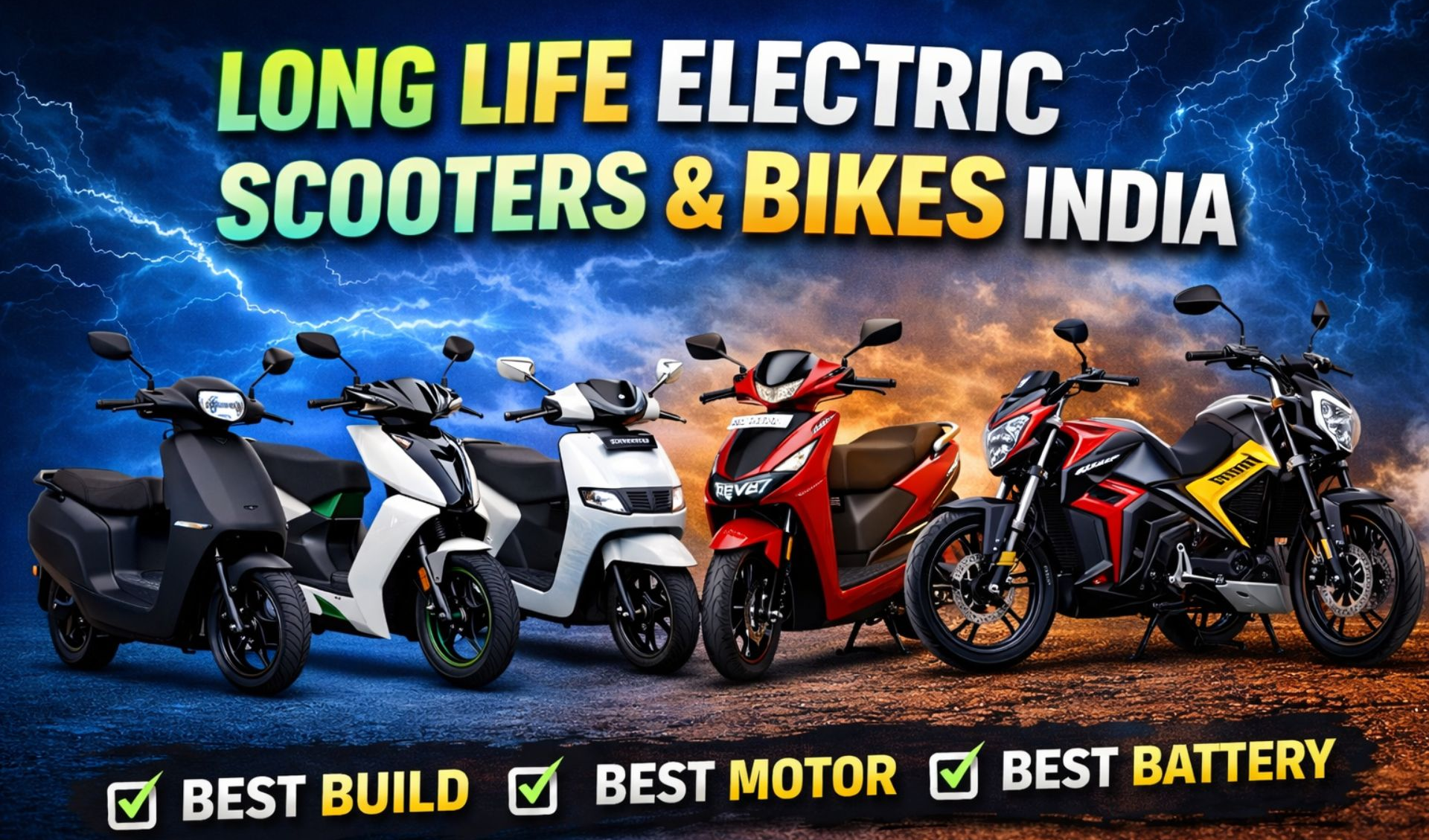
Buying an electric scooter or electric bike in India is no longer just about range numbers. If you want a long-life, practical and reliable EV, you must understand three critical things: Build Quality, Motor Technology and Battery Chemistry.
In this detailed guide, we clearly explain popular Indian EV brands like Ola Electric, Ather Energy, TVS iQube, Bajaj Chetak, Hero Vida, River Indie, Simple One, Ampere, Revolt and Oben — in a way that actually helps buyers.
1. Build Quality – Ranked from Best to Most Practical
Build quality decides how long your EV will survive Indian roads, weather, load and daily abuse. Even the best motor and battery cannot compensate for weak structural quality.
1. Bajaj Chetak – Best Overall Build Quality
Bajaj Chetak stands out with its full metal body. The scooter feels heavy, solid and extremely stable. It is designed for long-term ownership rather than flashy features.
- Good: Metal body, strong chassis, premium durability
- Bad: Slightly heavier than plastic scooters
2. Ather Energy (450X / Rizta)
Ather offers one of the best engineered scooters in India. The build quality is premium with excellent fit and finish, even though it uses high-grade plastics.
- Good: Premium quality, strong frame, refined ride
- Bad: No metal body
3. TVS iQube / TVS Orbiter
TVS focuses on practicality and reliability. The build is simple but durable, ideal for families and daily commuting.
- Good: Balanced, reliable, trusted brand
- Bad: Design not very exciting
4. River Indie
River Indie is built specifically for Indian conditions. It feels rugged, slightly bulky, but extremely practical for bad roads and load carrying.
- Good: Rugged design, water-dust protection
- Bad: Bulky size for tight city parking
5. Simple One
Simple One offers a premium and sporty design with advanced features. However, long-term durability is still being proven in real-world conditions.
- Good: Premium look, modern features
- Bad: New brand, long-term reliability yet to be proven
6. Ola Electric Scooters
Ola scooters are tech-loaded and futuristic. The design is attractive, but build quality relies heavily on plastics.
- Good: Stylish, high-tech dashboard
- Bad: Plastic-heavy construction
7. Hero Vida
Hero Vida is practical and user-friendly, especially because of its removable battery. Build quality is decent but not premium.
- Good: Practical design, removable battery
- Bad: Average structural feel
8. Ampere Electric Scooters
Ampere scooters are built for budget buyers. The construction is lightweight and basic.
- Good: Affordable, simple
- Bad: Lower durability for long-term use
Electric Bikes – Revolt & Oben
Electric bikes naturally have stronger frames than scooters. Oben focuses on performance and sporty build, while Revolt is more commuter-oriented.
2. Motor Technology
Motor technology decides performance, smoothness, efficiency and long-term reliability. In India, EVs mainly use BLDC and PMSM motors.
BLDC Motor – Simple & Reliable
BLDC motors are cost-effective, low-maintenance and ideal for city riding.
- Brands using BLDC: Bajaj Chetak, TVS iQube, Ampere
- Best for: Daily office commute, family users
- Downside: Lower efficiency compared to PMSM
PMSM Motor – Best Overall Choice
PMSM motors are more efficient, smoother and generate less heat. They help improve real-world range and motor life.
- Brands using PMSM: Ather Energy, Hero Vida (higher variants), River Indie, Simple One
- Best for: Long-term ownership, smooth performance
- Downside: Slightly higher cost
High-Performance Motors
Some brands focus on power and acceleration rather than efficiency.
- Ola Electric: Performance-focused high-power motors
- Oben: Sporty electric bike motor
- Revolt: Balanced commuter bike motor
3. Battery Technology – NMC vs LFP Explained Clearly
Battery chemistry decides range, safety and long-term degradation. Indian EVs mainly use NMC batteries, while LFP is emerging as a long-life option.
NMC Battery – Higher Energy Density
NMC batteries offer better range in lighter weight but require good thermal management.
- Used by: Ola Electric, Ather, TVS iQube, Bajaj Chetak, Hero Vida, Simple One, Revolt, Oben
- Pros: Better range, compact size
- Cons: Faster degradation if charging habits are poor
LFP Battery – Long Life & Safety Focused
LFP batteries offer more charge cycles, better thermal safety and longer lifespan. They are slightly heavier but ideal for long-term ownership.
- Used / Moving towards: River Indie and future EV models
- Pros: Safer, longer battery life
- Cons: Lower energy density
If your priority is long life and practicality, focus on:
- Best Build Quality: Bajaj Chetak, Ather, TVS iQube
- Best Motor Technology: PMSM
- Best Battery Life: LFP & high-quality NMC packs
Do not choose an electric scooter only by advertised range. A well-built EV with an efficient motor and safe battery will save money and stress in the long run.
Author’s Note
This guide is written for Indian buyers who want honest, real-world EV advice — not marketing claims.
Why Electric Scooters Are Better Than Petrol Scooters in India
Electric vs Petrol – Real World Comparison for Indian Riders
For decades, petrol scooters dominated Indian roads because there was no alternative. Today, electric scooters are no longer experimental products. They have evolved into practical, reliable and cost-effective mobility solutions.
Let us clearly understand why electric scooters are better than petrol scooters, especially for Indian road conditions, traffic and daily usage.
1. Running Cost – Biggest Advantage of Electric Scooters
The most obvious and important advantage of electric scooters is their extremely low running cost. A petrol scooter typically costs ₹2.5–₹3.5 per kilometer depending on fuel prices.
In comparison, an electric scooter costs roughly ₹0.25–₹0.40 per kilometer when charged at home. That means your monthly commuting expense drops drastically.
- Petrol scooter (1,000 km/month): ₹3,000+ fuel cost
- Electric scooter (1,000 km/month): ₹300–₹400 electricity cost
Over 3–4 years, this difference alone can recover the higher initial price of an EV.
2. Maintenance – No Engine, No Headache
A petrol scooter has many moving parts: engine oil, filters, clutch, belt, spark plug, exhaust system and gearbox components. All these parts wear out and require periodic servicing.
An electric scooter has very few moving parts. There is no engine oil, no clutch, no gearbox and no exhaust.
- No oil change
- No engine overheating issues
- No vibration-related wear
- Lower service frequency
This makes electric scooters ideal for users who want hassle-free ownership.
3. Smooth & Silent Riding Experience
Electric scooters deliver instant torque. There is no lag, no gear shifting and no engine noise. This makes riding in city traffic extremely smooth.
In contrast, petrol scooters feel noisy, vibratory and less refined, especially during stop-and-go traffic.
For daily office commuters and family users, this silent and vibration-free ride significantly reduces fatigue.
4. Environment & Heat Management in Cities
Indian cities already suffer from pollution and heat. Petrol scooters contribute directly to:
- Air pollution
- Noise pollution
- Urban heat buildup
Electric scooters produce zero tailpipe emissions and significantly less heat. While electricity generation may not be 100% green, EVs still reduce overall urban pollution levels.
This is especially important in densely populated Indian cities.
5. Home Charging Convenience
One of the biggest mindset shifts is charging. Electric scooters can be charged at home overnight, just like a mobile phone.
This removes the daily dependency on fuel stations. You start every morning with a “full tank”.
Petrol scooters, on the other hand, require regular refueling trips, which becomes inconvenient over time.
6. Government Support & Future Readiness
The Indian government is actively promoting electric mobility. EVs receive:
- Lower road tax or exemptions
- Registration benefits
- Policy support for charging infrastructure
At the same time, petrol vehicles will face stricter emission norms and higher compliance costs in the future.
Buying an electric scooter today is also a future-proof decision.
7. Ideal for Indian Usage Pattern
Most Indian scooter users ride:
- 30–50 km per day
- Mainly inside cities
- At moderate speeds
This usage pattern perfectly matches the strengths of electric scooters. You do not need extreme top speed or highway range for daily commuting.
For this reason, electric scooters are not just alternatives — they are actually better suited for Indian conditions.
8. Are Petrol Scooters Still Relevant?
Petrol scooters still make sense for:
- Very long-distance rural usage
- Areas with no charging access
- Users who frequently ride 150+ km in a day
However, for urban and semi-urban India, electric scooters clearly offer more advantages than disadvantages.
Final Conclusion – Electric Scooters Are the Smarter Choice
Electric scooters are not perfect, but they are evolving rapidly. Better batteries, stronger build quality and improved motors are making EVs more reliable every year.
If your goal is:
- Low running cost
- Low maintenance
- Silent & smooth ride
- Future-ready mobility
Then an electric scooter is clearly a better choice than a petrol scooter in India today.