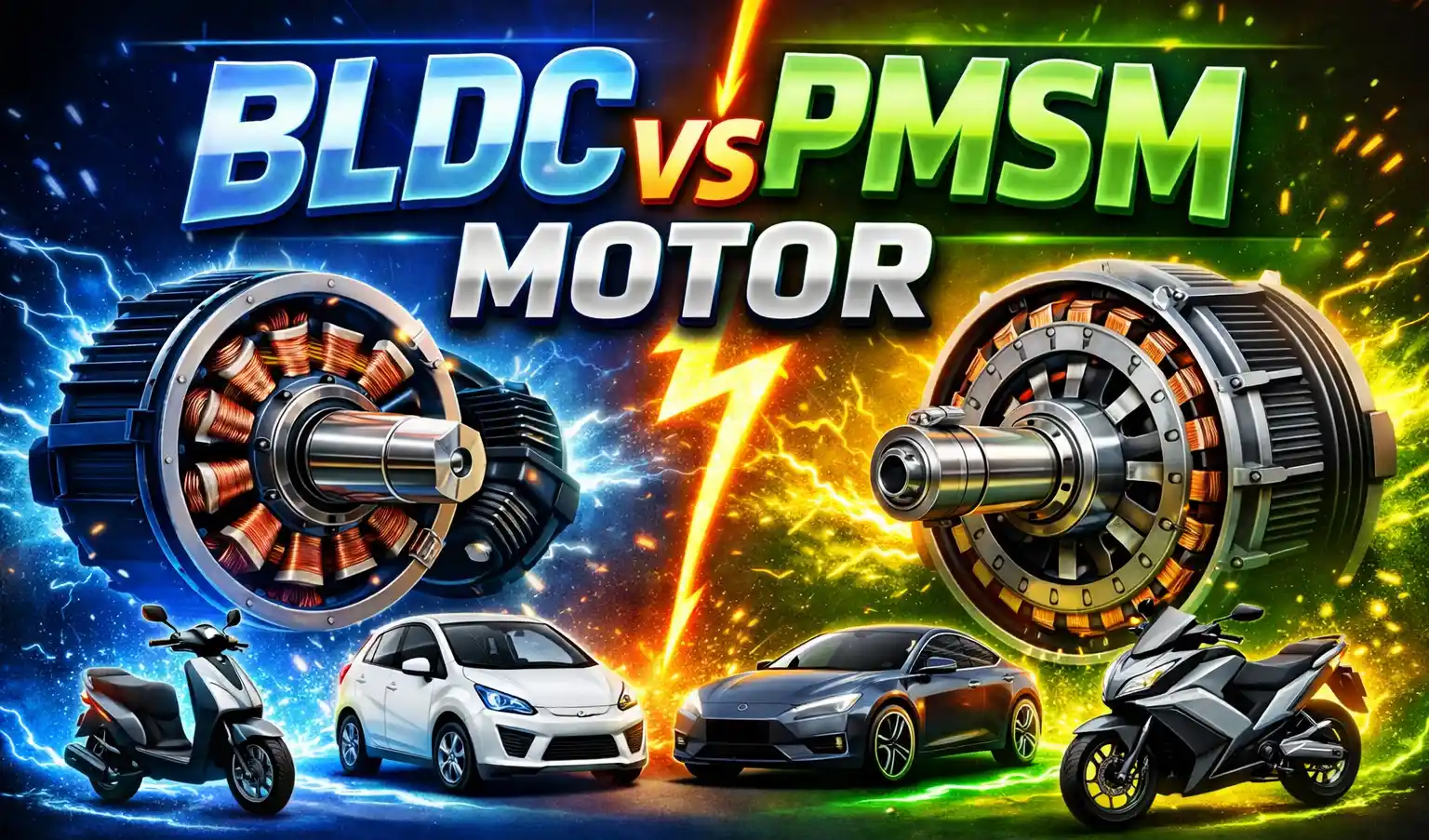
In the modern world of electrification, electric motors play a crucial role in determining performance, efficiency, reliability, and user experience. Among the most discussed motor technologies today are BLDC (Brushless Direct Current) motors and PMSM (Permanent Magnet Synchronous Motors). These motors are widely used in electric vehicles (EVs), electric scooters, e-bikes, industrial automation, robotics, HVAC systems, and renewable energy solutions.
This detailed blog explains BLDC and PMSM motors in depth, covering their working principles, construction, control methods, efficiency, noise levels, cost factors, real-world applications, advantages, disadvantages, and a clear comparison to help you choose the right motor. This article is written in simple yet technical English, suitable for beginners, enthusiasts, engineers, and EV buyers.
1. What is an Electric Motor?
When electric current flows through coils placed inside a magnetic field, it produces a force (Lorentz force) that causes rotation. The way current is supplied, controlled, and synchronized with the magnetic field defines different types of motors.
BLDC and PMSM motors both belong to the category of brushless permanent magnet motors, meaning they do not use carbon brushes and rely on electronic controllers for operation.
2. What is a BLDC Motor?
2.1 Definition
A BLDC (Brushless Direct Current) motor is a type of electric motor that uses direct current (DC) supplied through an electronic controller instead of mechanical brushes. Permanent magnets are mounted on the rotor, while the stator contains copper windings.
2.2 Construction of BLDC Motor
- Rotor: Permanent magnets (usually Neodymium magnets)
- Controller: Electronic Speed Controller (ESC)
- Sensors: Hall-effect sensors (optional)
2.3 Working Principle of BLDC Motor
Although called a DC motor, a BLDC motor internally works on AC principles. The DC supply from the battery is converted into three-phase AC by the controller. This creates a rotating magnetic field in the stator, which pulls the permanent magnet rotor along, causing rotation.
Most BLDC motors use trapezoidal back EMF and are commutated electronically in six steps (six-step commutation).
2.4 Types of BLDC Motors
- Inner Rotor BLDC Motor
- Outer Rotor BLDC Motor
- BLDC Hub Motor (used in electric scooters and e-bikes)
3. What is a PMSM Motor?
3.1 Definition
A PMSM (Permanent Magnet Synchronous Motor) is an AC motor that uses permanent magnets on the rotor and operates in synchronism with the rotating magnetic field of the stator. The rotor speed is exactly equal to the stator magnetic field speed.
3.2 Construction of PMSM Motor
- Stator: Three-phase distributed windings
- Rotor: Permanent magnets (surface-mounted or interior)
- Inverter: Advanced motor controller
- Sensors: Encoder or resolver (optional)
3.3 Working Principle of PMSM Motor
PMSM motors operate using a sinusoidal AC supply generated by an inverter. The stator produces a smooth rotating magnetic field, and the rotor magnets lock into this field, rotating synchronously without slip.
PMSM motors typically use sinusoidal back EMF and advanced control techniques such as Field-Oriented Control (FOC).
4. BLDC vs PMSM: Key Technical Differences
| Parameter |
BLDC Motor |
PMSM Motor |
| Supply Type |
DC (converted to trapezoidal AC) |
AC (sinusoidal) |
| Back EMF |
Trapezoidal |
Sinusoidal |
| Control Method |
Six-step commutation |
FOC / Vector control |
| Efficiency |
High |
Very High |
| Noise & Vibration |
Moderate |
Very Low |
| Cost |
Lower |
Higher |
5. Efficiency Comparison
Both motors are highly efficient compared to brushed motors. However, PMSM motors typically achieve 92–97% efficiency, while BLDC motors operate around 85–92%. The higher efficiency of PMSM motors results from smoother current waveforms and optimized magnetic utilization.
In electric vehicles, higher efficiency directly translates to better range and lower heat generation.
6. Noise, Vibration, and Smoothness
BLDC motors can produce audible noise and torque ripple due to trapezoidal commutation. This is more noticeable at low speeds.
PMSM motors are significantly quieter and smoother because of sinusoidal current control and precise rotor alignment. This makes PMSM motors ideal for premium electric cars and high-end electric bikes.
7. Controller Complexity
BLDC controllers are simpler, cheaper, and easier to design. They often use Hall sensors for rotor position detection.
PMSM controllers are more complex and require advanced algorithms like FOC, along with higher processing power. This increases system cost but delivers superior performance.
8. Applications of BLDC Motors
- Electric scooters and e-bikes
- Electric fans and home appliances
- Water pumps
- Drones
- Low-cost EVs
9. Applications of PMSM Motors
- Electric cars (EVs)
- Premium electric motorcycles
- Industrial automation
- Robotics
- CNC machines
10. BLDC vs PMSM in Electric Vehicles
Most electric scooters in India use BLDC hub motors due to simplicity and lower cost. In contrast, electric cars and premium bikes use PMSM motors with belt or chain drive for higher efficiency and performance.
PMSM motors provide better torque control, higher top speed stability, and smoother acceleration, which is critical for automotive-grade EVs.
11. Advantages and Disadvantages
BLDC Motor Advantages
- Lower cost
- Simple controller
- Low maintenance
BLDC Motor Disadvantages
- Higher noise
- Lower smoothness
PMSM Motor Advantages
- Highest efficiency
- Very smooth operation
- Excellent torque control
PMSM Motor Disadvantages
- High cost
- Complex control system
12. Which Motor Should You Choose?
If your priority is affordability and simplicity, BLDC motors are the right choice. If you need premium performance, maximum efficiency, and silent operation, PMSM motors are superior.
For electric scooters and budget EVs, BLDC motors are sufficient. For electric cars, high-speed bikes, and industrial systems, PMSM motors are the future.
13. Future of BLDC and PMSM Motors
With advancements in semiconductor technology and motor control algorithms, PMSM motors are becoming more affordable. However, BLDC motors will continue to dominate cost-sensitive markets.
The future of electric mobility will largely depend on PMSM motors combined with intelligent motor controllers.
Frequently Asked Questions (FAQs) – BLDC vs PMSM Motor
What is the main difference between BLDC and PMSM motors?
The main difference between BLDC and PMSM motors is their control technique and back EMF waveform. BLDC motors use trapezoidal back EMF with six-step commutation, while PMSM motors use sinusoidal back EMF with Field-Oriented Control (FOC), making PMSM motors smoother and more efficient.
Which motor is better for electric scooters in India?
BLDC motors are more commonly used in electric scooters in India because they are affordable, reliable, and easy to maintain. PMSM motors are generally used in premium electric scooters and motorcycles where higher efficiency and smooth performance are required.
Why are PMSM motors more efficient than BLDC motors?
PMSM motors are more efficient because they use sinusoidal current waveforms and precise vector control. This reduces torque ripple, heat generation, and energy loss, resulting in better range and performance in electric vehicles.
Do BLDC motors produce more noise compared to PMSM motors?
Yes, BLDC motors can produce more noise and vibration, especially at low speeds, due to trapezoidal commutation. PMSM motors operate very smoothly and quietly because of sinusoidal control and accurate rotor position tracking.
Are PMSM motors used in electric cars?
Yes, most modern electric cars use PMSM motors because they offer high torque density, excellent efficiency, smooth acceleration, and stable performance at high speeds.
Is a PMSM motor more expensive than a BLDC motor?
PMSM motors are usually more expensive than BLDC motors because they require advanced inverters, complex control algorithms, and higher precision components.
Which motor is better for long-term electric vehicle use?
For long-term and high-performance electric vehicle usage, PMSM motors are a better choice due to their higher efficiency, lower heat generation, and smoother operation. BLDC motors remain a good option for budget-friendly and daily commuting electric vehicles.
Conclusion
Both BLDC and PMSM motors are essential technologies in the electric revolution. Understanding their differences helps engineers, manufacturers, and consumers make better decisions. While BLDC motors offer simplicity and cost-effectiveness, PMSM motors deliver unmatched efficiency and refinement.
Choosing the right motor depends on application, budget, performance expectations, and long-term efficiency goals.