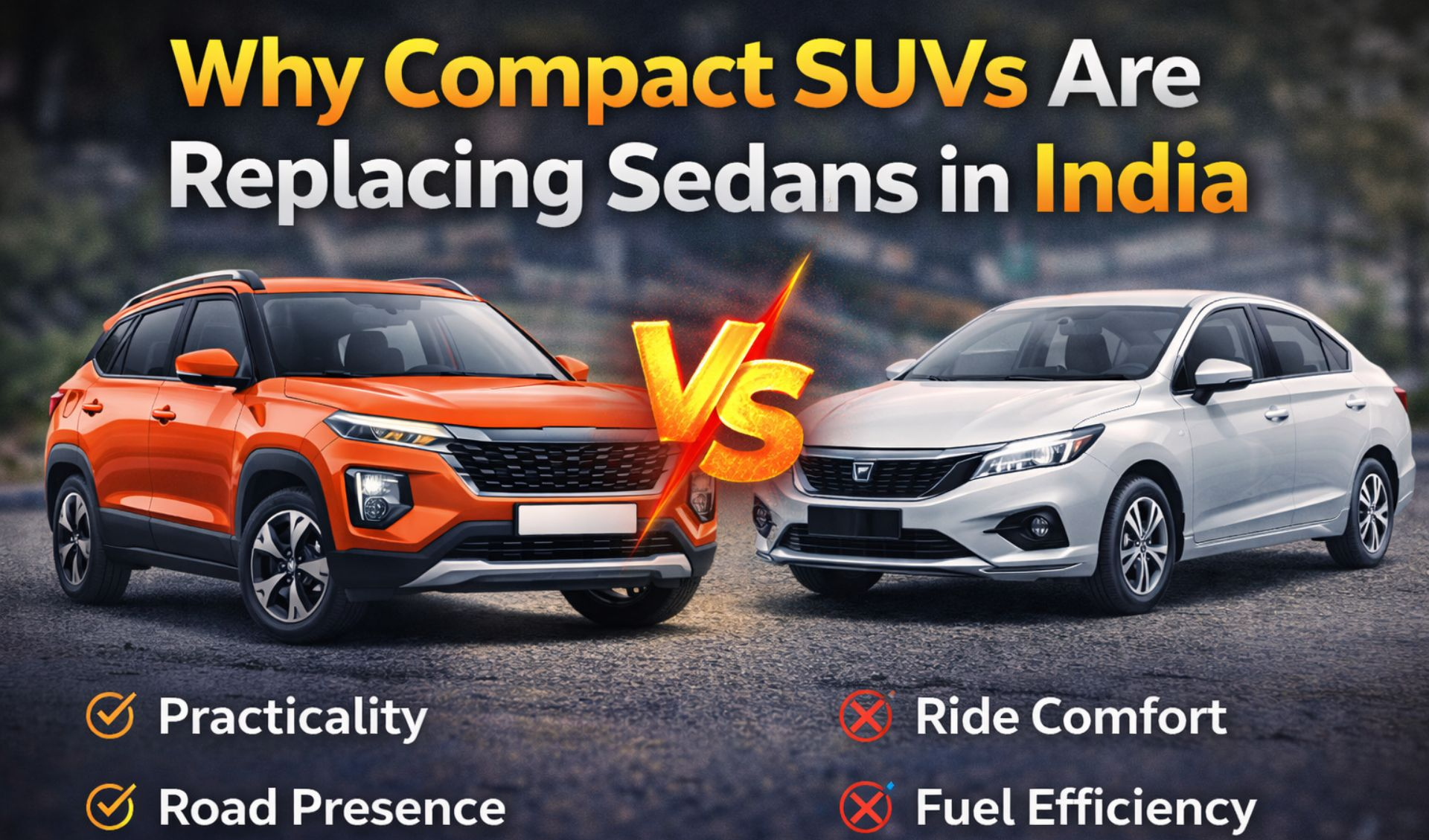
The Indian car market is undergoing one of its biggest transformations in decades. Once dominated by sedans, today the spotlight is firmly on compact SUVs. Cars that were once considered “premium alternatives” have now become the default choice for Indian buyers.
This shift is not accidental, nor is it driven by just one factor. It is the result of changing road infrastructure, evolving buyer mindset, improved SUV efficiency, and strategic decisions by car manufacturers.
To truly understand why compact SUVs are replacing sedans in India, we need to look beyond surface-level reasons and analyze real-world ownership, psychology, and long-term practicality.
1. Indian Road Reality Favors SUVs, Not Sedans
Indian roads are a mixed reality. While highways in metro cities have improved, the moment you exit city limits, conditions change drastically. Broken patches, uneven tarmac, unscientific speed breakers, waterlogging during monsoons, and poorly designed entry ramps are common across the country.
Sedans are designed for smoother roads. Their low ground clearance and long wheelbase make them vulnerable to underbody hits. Even careful drivers often experience scraping, especially with a fully loaded car.
Compact SUVs, with their higher ground clearance and tougher suspension setup, absorb these challenges better. For buyers, this translates into peace of mind — less worrying about every pothole or speed breaker.
This single factor alone has pushed many Indian buyers away from sedans.
2. High Seating Position Is No Longer a Luxury, It’s a Preference
The psychological comfort of sitting higher cannot be ignored. Compact SUVs offer an upright seating position that gives drivers a clearer view of traffic, pedestrians, and road obstacles.
In Indian traffic conditions — where lane discipline is unpredictable — visibility becomes a safety advantage. New drivers, elderly drivers, and even experienced city commuters prefer this commanding view.
Sedans provide better cornering dynamics, but for most Indian buyers, daily driving comfort matters more than handling precision.
3. One-Car Solution for Multiple Use Cases
Indian households usually own one primary car. That car must handle:
- Daily office commute
- Weekend highway drives
- Village visits
- Family trips with luggage
Sedans perform brilliantly on highways but feel limited on rough or broken roads. Compact SUVs, however, deliver acceptable comfort on highways while also being capable on bad roads.
This versatility makes compact SUVs a better “one-car garage” solution — a crucial factor in a price-sensitive market like India.
4. Changing Buyer Psychology and Aspirations
Earlier, sedans were seen as a symbol of success. Today, success is defined differently. Buyers want cars that reflect an active, adventurous lifestyle.
Compact SUVs fit perfectly into this narrative. They look ready for road trips, outdoor activities, and weekend escapes. Even if the buyer never goes off-road, the image matters.
Sedans, while elegant, are now perceived as more traditional or conservative — a perception that hurts their appeal among younger buyers.
5. Improved Fuel Efficiency Has Reduced Sedan Advantage
Fuel efficiency was once the strongest weapon sedans had. Lower weight and better aerodynamics gave them a clear edge.
Modern compact SUVs, however, use:
- Turbo-petrol engines
- Lightweight platforms
- Start-stop technology
As a result, the mileage gap between sedans and compact SUVs has narrowed significantly. For many buyers, the difference is no longer big enough to influence the decision.
6. Safety Perception Plays a Big Role
Even before crash test ratings became mainstream, Indian buyers associated bigger cars with better safety.
Compact SUVs appear stronger due to:
- Taller stance
- Wider body
- Larger tyres
With the introduction of features like six airbags, ESC, hill-hold assist, and ADAS in compact SUVs, this perception has strengthened further.
Sedans may offer similar safety features, but perception often outweighs technical reality in buying decisions.
7. Cabin Space Feels More Usable in SUVs
On paper, sedans may offer more legroom. In reality, compact SUVs feel airier due to:
- Higher roofline
- Better headroom
- Upright seating
Indian families value comfort for rear-seat passengers, especially elders. Getting in and out of a sedan can be inconvenient due to low seat height.
Compact SUVs solve this problem effortlessly.
8. Pricing Strategy Has Shifted the Market
Manufacturers have aggressively priced compact SUVs to compete directly with sedans. In many cases:
- Top-end compact SUVs cost the same as mid-variant sedans
- SUVs offer more features at similar prices
When buyers see more value for money, the decision becomes straightforward.
Sedans now struggle to justify their pricing unless they offer exceptional performance or premium branding.
9. Brand Focus and Product Lifecycle Bias
Car makers follow demand. Since SUVs sell more, companies:
- Launch new SUVs frequently
- Update SUVs faster
- Market SUVs aggressively
Sedans, in contrast, receive fewer updates and limited promotional support. Over time, this reduces visibility and buyer interest.
A product that feels neglected automatically loses market relevance.
10. Resale Value Favors Compact SUVs
Resale value is a major consideration in India. Compact SUVs currently enjoy stronger resale demand compared to sedans.
Higher resale value reduces long-term ownership cost, making SUVs a safer financial choice.
Sedans, especially non-popular models, tend to depreciate faster.
Will Sedans Make a Comeback?
Sedans are not obsolete. They still offer:
- Superior ride comfort
- Better high-speed stability
- Lower road noise
However, unless Indian road infrastructure improves significantly and buyer priorities shift again, sedans will remain a niche choice rather than a mainstream one.
Final Conclusion
Compact SUVs are replacing sedans in India because they align better with real-world conditions, modern aspirations, and practical ownership needs.
This shift is not driven by hype alone — it is rooted in logic, usability, and perception. Compact SUVs offer a balanced package that fits the Indian lifestyle perfectly.
For the foreseeable future, compact SUVs will continue to dominate Indian roads, while sedans evolve into a specialized segment for buyers who prioritize driving comfort above all else.