EV Passenger Vehicle Market Continues Steady Growth
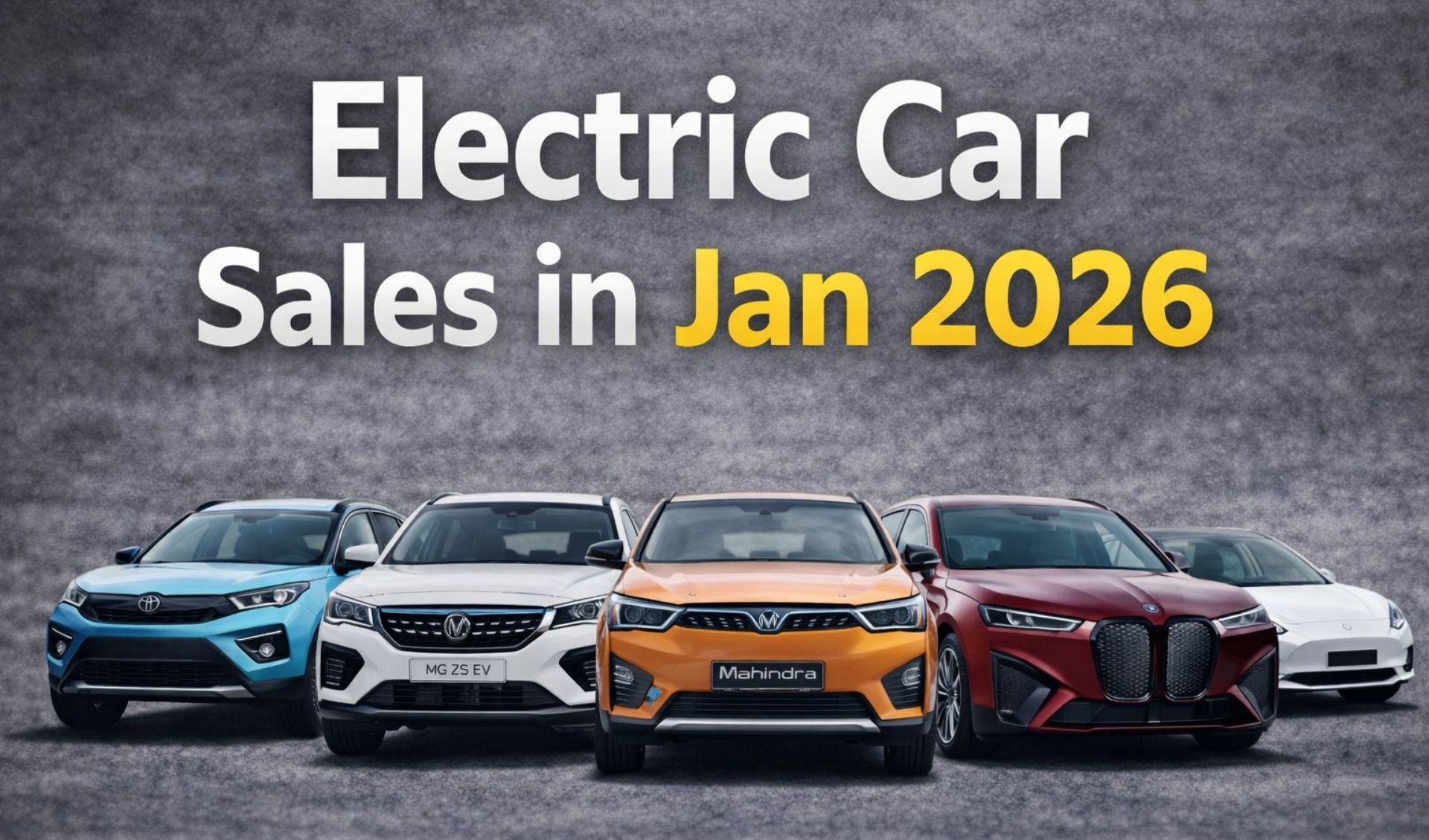
India’s electric car market continued its upward momentum in January 2026. Total electric passenger vehicle sales reached 16,719 units, compared to 15,269 units in December 2025, registering a month-on-month growth of 9.5%.
While the growth rate is lower than the two-wheeler EV segment, electric cars are clearly moving beyond early adoption and entering a phase of gradual mass acceptance.
Overall EV Car Market Snapshot – January 2026
- Total Sales (Jan 2026): 16,719 units
- Total Sales (Dec 2025): 15,269 units
- MoM Growth: +9.5%
- Market Leader: Tata Motors
1. Tata Motors – Dominating India’s EV Car Market
December 2025: 6,526 units
January 2026: 7,075 units
MoM Growth: +8.41%
Market Share: 42.30%
Tata Motors continues to dominate India’s electric car segment with over 42% market share. Its success is driven by a wide EV portfolio, competitive pricing, and strong charging ecosystem support.
2. JSW MG Motor – Strong Second Position
December 2025: 3,719 units
January 2026: 4,374 units
MoM Growth: +17.61%
Market Share: 26.16%
MG Motor recorded one of the highest growth rates in January 2026. The brand continues to attract tech-focused EV buyers looking for premium features.
3. Mahindra & Mahindra – Expanding EV Presence
December 2025: 3,055 units
January 2026: 3,415 units
MoM Growth: +11.78%
Market Share: 20.43%
Mahindra remains a strong player in the electric SUV space, benefiting from its SUV-focused strategy and brand trust in India.
4. VinFast – Entry-Level Growth Phase
December 2025: 384 units
January 2026: 416 units
MoM Growth: +8.33%
Market Share: 2.49%
VinFast continues its gradual expansion, focusing on brand awareness and dealership growth.
5. BMW India – Premium EV Slowdown
December 2025: 356 units
January 2026: 299 units
MoM Growth: –16.01%
Market Share: 1.79%
BMW witnessed a decline in January, indicating fluctuating demand in the luxury EV segment.
6. Kia India – Marginal Dip
December 2025: 311 units
January 2026: 255 units
MoM Growth: –18.01%
Market Share: 1.53%
Kia’s EV volumes dipped slightly, reflecting limited product availability in the electric segment.
7. Hyundai Motor – Positive Momentum
December 2025: 272 units
January 2026: 315 units
MoM Growth: +15.81%
Market Share: 1.88%
Hyundai showed encouraging growth, suggesting increasing acceptance of its electric offerings.
8. BYD India – Stable Performance
December 2025: 236 units
January 2026: 199 units
MoM Growth: –15.68%
Market Share: 1.19%
BYD continues to cater to a niche audience focused on long-range electric cars.
9. Mercedes-Benz – Luxury EV Niche
December 2025: 71 units
January 2026: 66 units
MoM Growth: –7.04%
Market Share: 0.39%
10. Tesla – Limited Volumes
December 2025: 69 units
January 2026: 37 units
MoM Growth: –46.38%
Market Share: 0.22%
Tesla sales remain limited due to restricted availability and premium pricing
Why Electric Cars Are Gaining Attention in 2026
The growing interest in electric cars is driven by a combination of economic, environmental, and technological factors. Petrol and diesel prices remain volatile, making EVs attractive due to their significantly lower running costs. At the same time, battery technology has improved, offering better range and reliability than earlier generations.
Government incentives, reduced road tax in many states, and expanding charging infrastructure have also contributed to growing confidence among buyers. For many urban consumers, electric cars are now viewed as practical daily commuters rather than experimental alternatives.
Brand-Wise Electric Car Market Performance
The Indian electric car market is currently dominated by a few key players, with others gradually finding their footing. January 2026 sales numbers reveal how different brands are performing and where buyer trust is strongest.
Tata Motors: The EV Market Leader
Tata Motors continues to command the electric car segment with a dominant market share. Models like the Nexon EV and Tiago EV have proven that electric cars can be reliable, affordable, and practical for Indian conditions. Tata’s local manufacturing advantage and extensive service network have helped the brand build trust faster than its competitors.
MG Motor: Urban-Focused EV Strategy
MG Motor has positioned itself as a modern, tech-driven EV brand. The Comet EV, in particular, has found favor among city users who prioritize compact size and ease of driving. MG’s steady growth indicates that urban India is warming up to electric mobility.
Mahindra & Mahindra: Preparing for the Next EV Wave
Mahindra’s electric journey is still evolving. While current sales are moderate, upcoming born-electric platforms signal a more aggressive future strategy. Mahindra’s brand trust in SUVs could play a major role once its next-generation EVs hit the market.
Premium Brands and Their Challenges
Luxury brands like BMW, Mercedes-Benz, and Tesla continue to struggle with volumes. High prices, limited charging infrastructure, and a niche customer base restrict growth. However, these brands play an important role in showcasing advanced EV technology and performance benchmarks.
Cost of Ownership: Electric vs Petrol Cars
One of the biggest advantages of electric cars is their low running cost. Charging an EV costs significantly less than refueling a petrol or diesel car. Additionally, electric cars have fewer moving parts, which reduces maintenance expenses.
However, the initial purchase price of electric cars is still higher than comparable petrol vehicles. While subsidies help bridge the gap, battery costs remain a key factor. Over long-term ownership, EVs often become more economical, especially for high-usage city drivers.
Charging Infrastructure: Reality on Indian Roads
Charging infrastructure has improved in major cities and highways, but it remains uneven across the country. Home charging is still the most reliable solution for EV owners. For apartment dwellers and frequent highway travelers, charging access can still be a concern.
Fast-charging networks are expanding, but charging time remains longer than refueling an ICE car. This is one area where electric cars still lag behind conventional vehicles.
Is 2026 the Right Time to Buy an Electric Car?
The answer depends largely on your usage pattern. Electric cars are ideal for daily city driving, short commutes, and predictable travel routines. If your driving is mostly within 100–300 km per day, an EV can be a smart and economical choice.
However, if you frequently travel long distances, rely heavily on highway infrastructure, or live in regions with limited charging support, waiting another couple of years may be a better decision.
Future of Electric Cars in India
The future of electric cars in India looks strong. Battery prices are expected to decline, ranges will improve, and charging infrastructure will continue to expand. More affordable EV models are likely to enter the market, making electric mobility accessible to a wider audience.
Government policies and global emission commitments also indicate that electric vehicles will play a central role in India’s automotive future. While ICE vehicles will not disappear overnight, electric cars are clearly moving from early adoption to mass acceptance.
Final Verdict: Is 2026 the Right Time to Buy an Electric Car?
January 2026 sales data clearly shows that electric cars in India are gaining steady traction. For city users, daily commuters, and environmentally conscious buyers, EVs make strong financial sense.
However, buyers should carefully evaluate charging access, driving range, and long-term ownership costs. With improving infrastructure and upcoming models, electric cars are moving closer to mainstream adoption.
2026 may not be the peak, but it is certainly a smart entry point into India’s electric car revolution.