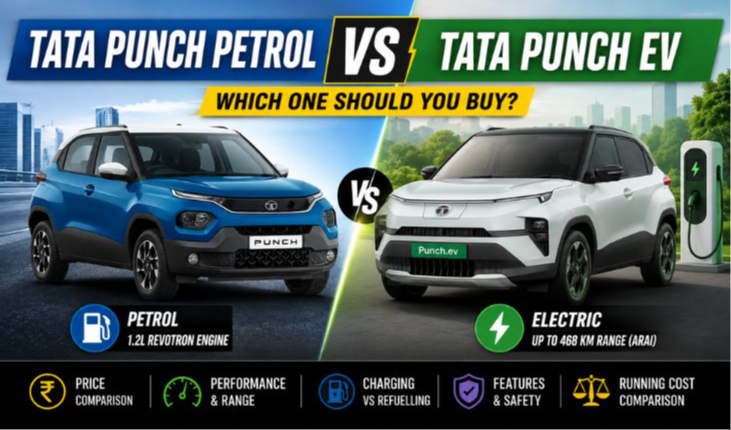
Tata Punch is one of the most popular compact SUVs in India because it offers SUV-like styling, high ground clearance, practical cabin space and strong safety appeal in a compact size. Now buyers have two major choices: Tata Punch Petrol and Tata Punch EV. Both cars carry the Punch name, but their ownership experience is very different.
The petrol Punch is made for buyers who want a lower starting price, easy fuel availability and simple long-distance usage. The Punch EV is made for buyers who want silent driving, lower running cost, modern EV features and zero tailpipe emission. In this comparison, we will check both cars based only on official Tata Motors website information.
Quick Verdict
Buy Tata Punch Petrol if you want a lower purchase price, easy refuelling and regular highway use without charging planning.
Buy Tata Punch EV if your daily running is high, you have charging access at home or office, and you want lower running cost with modern EV features.
Tata Punch Petrol vs Tata Punch EV: Key Comparison
| Category |
Tata Punch Petrol |
Tata Punch EV |
| Powertrain |
1.2L Revotron petrol engine |
Permanent Magnet Synchronous Motor |
| Power |
88 PS |
65 kW / 90 kW depending on battery option |
| Torque |
115 Nm |
175 Nm / 190 Nm depending on battery option |
| Battery |
Not applicable |
30 kWh / 40 kWh |
| Range |
Depends on fuel and driving style |
Up to 468 km ARAI |
| Charging |
Petrol refuelling |
20-80% fast charging in 26 minutes |
| Starting Price |
₹5.64 lakh* |
₹9.69 lakh* |
Tata Punch Petrol: Engine and Performance
The Tata Punch Petrol comes with a 1.2L Revotron petrol engine. According to Tata Motors’ official specification page, this engine produces 88 PS power and 115 Nm torque. This setup is suitable for city driving, daily office use, family usage and occasional highway trips.
The biggest advantage of petrol is convenience. You can refuel quickly at any petrol pump. For buyers who frequently travel between cities, visit villages, or drive in areas where EV charging infrastructure is still limited, the Punch Petrol feels easier to live with.
The Punch Petrol is also more affordable at the time of purchase. Tata lists the Punch Petrol starting from ₹5.64 lakh*, which makes it much cheaper than the EV version. If your budget is tight and your monthly running is not very high, the petrol Punch can be the more practical option.
Tata Punch EV: Battery, Motor and Range
The Tata Punch EV is a more modern and technology-focused version of the Punch. Officially, Tata Punch EV is available with 30 kWh and 40 kWh battery pack options. The EV uses a Permanent Magnet Synchronous Motor.
The 30 kWh version produces 65 kW power and 175 Nm torque, while the 40 kWh version produces 90 kW power and 190 Nm torque. This means the Punch EV offers stronger instant torque compared to the petrol version. In city traffic, this instant response makes the EV feel smooth and quick.
The biggest highlight is range. Tata mentions an ARAI range of up to 468 km for the Punch EV. For daily city use, this range is more than enough for many users. If your daily running is around 40 to 80 km, you may not need to charge every day.
Charging vs Refuelling
This is one of the biggest differences between both cars. Tata Punch Petrol can be refuelled in just a few minutes. This is a major benefit for highway users and people who do not have fixed parking or home charging.
Tata Punch EV needs charging, but Tata has improved the charging experience. The official Punch EV page mentions 20-80% fast charging in 26 minutes. This is useful for quick top-ups during travel. However, for best ownership experience, EV buyers should ideally have home charging or office charging access.
If you live in an apartment where charging is difficult, petrol may still be easier. But if you have a dedicated parking space with charging, the Punch EV can be more convenient because you can charge overnight and start every morning with enough range.
Running Cost: Petrol vs EV
The Tata Punch EV’s biggest long-term benefit is lower running cost. Electric cars generally cost much less per kilometre compared to petrol cars, especially if you charge at home. This matters a lot for users who drive daily.
For example, if your monthly running is high, the higher purchase price of the Punch EV can be balanced over time through lower electricity cost and reduced fuel expense. On the other hand, if you drive only occasionally, the petrol Punch may make more sense because the upfront price is much lower.
Features and Driving Experience
The Punch Petrol offers a familiar driving experience. It feels like a normal compact SUV, and anyone shifting from another petrol car will feel comfortable. It is simple, practical and easy to maintain through Tata’s service network.
The Punch EV feels more futuristic. It offers silent driving, instant acceleration, regenerative braking and EV-specific technology. Multi-mode regenerative braking helps recover energy while slowing down. The Punch EV also gets connected features depending on variant.
For city users, the EV driving experience is very smooth because there are no gear changes and no engine vibration. In traffic, this makes driving more relaxed. Petrol, however, remains better for users who do not want to think about charging.
Safety and Practicality
Both versions carry Tata’s strong safety-focused image. The Punch body style is compact but SUV-like, making it suitable for Indian roads. The high seating position, compact size and practical cabin make it good for families.
The petrol Punch is better for people who need maximum flexibility in every location. The EV is better for people who mostly drive in cities and have predictable daily usage. In practicality, the right choice depends more on your lifestyle than only specifications.
Which One Is Best for City Use?
For city use, the Tata Punch EV is the better choice if charging is available. Its instant torque, silent cabin, lower running cost and easy drive feel make it very comfortable in traffic. You do not need to visit petrol pumps frequently, and charging at home can save time.
However, if you live in a rented house, apartment or area where charging is not possible, the Punch Petrol is safer and easier to own. It may cost more to run, but it removes charging stress.
Which One Is Best for Highway Use?
For regular long highway trips, the Punch Petrol is more convenient because petrol pumps are available almost everywhere. You can refuel quickly and continue your journey.
The Punch EV can also do highway trips, especially with its long-range battery option, but you need charging planning. Fast charging support helps, but EV highway driving still needs more planning compared to petrol.
Who Should Buy Tata Punch Petrol?
- Buy it if your budget is limited.
- Buy it if you drive less every month.
- Buy it if you travel on highways often.
- Buy it if you do not have home charging.
- Buy it if you want simple and familiar ownership.
Who Should Buy Tata Punch EV?
- Buy it if your daily running is high.
- Buy it if you have home or office charging.
- Buy it if you want lower running cost.
- Buy it if you want silent and smooth driving.
- Buy it if you want modern EV technology.
Final Conclusion
The Tata Punch Petrol and Tata Punch EV are both good choices, but they are made for different buyers. The Tata Punch Petrol is best for budget-focused buyers, occasional users and people who need easy long-distance flexibility. It has a lower starting price and simple petrol refuelling convenience.
The Tata Punch EV is best for daily city users, high-running customers and people who want lower running cost with a modern driving experience. Its 30 kWh and 40 kWh battery options, up to 468 km ARAI range and 26-minute fast charging make it a strong EV option.
So, if you want value and flexibility, choose Punch Petrol. If you want future-ready ownership and low running cost, choose Punch EV.
Final Recommendation: For most city users with charging access, Tata Punch EV is the better long-term choice. For buyers with tight budget or frequent highway travel, Tata Punch Petrol is the safer option.